What Is Cashmere? A Complete Guide to the Fibre, and How to Judge It Before You Buy
A cone of undyed cashmere sitting on a rack in Scotland looks like almost nothing. Pale, slightly dusty, no weight to speak of. Hold it and the first thought is usually that somebody has handed you an empty cardboard tube.
Then you knit it, and the thing that comes off the machine is warmer than a jumper twice its weight.
That gap between how the raw material looks and what it does is a large part of why cashmere carries the reputation it has, and also why so much nonsense gets written about it. Almost every shopper knows the word. Rather fewer could tell you which animal it comes from, why one jumper costs sixty pounds and another four hundred, or what separates the piece that lasts fifteen years from the one that pills into a mess by February.
We have worked with this yarn for a long time, spun by Todd & Duncan in Scotland, established 1867, and knitted in our own factory in Leicestershire. Long enough to have opinions, some of them slightly against the grain of what the wider trade says.
What follows is the honest version. Where the fibre comes from, how it is processed, how quality is actually measured, and what to look at before you spend.
What Cashmere Actually Is
Start with the animal, because everything follows from it.
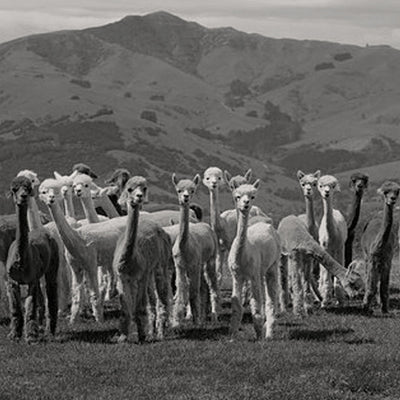
Cashmere is the fine, dehaired undercoat produced by the cashmere goat, Capra hircus laniger. Unlike sheep, which grow a single fleece, these goats carry two distinct coats. An outer layer of coarse guard hair, typically 40 to 60 microns thick, which sheds rain and snow. Beneath that sits the soft undercoat, grown through autumn and winter as insulation against genuinely brutal cold.
Only the second of those becomes the yarn we knit. The first is stripped out and sold on for brushes, felt and industrial uses.
Chemically it is a natural protein fibre, built from keratin, which is the same material as human hair and sheep's wool. That protein structure explains most of its behaviour: it absorbs moisture without feeling wet, resists odour-producing bacteria, and breaks down in soil at the end of its life rather than sitting in landfill for centuries.
The legal definition, which is stricter than most people expect
There is an actual standard here, not just marketing convention. Under the US Wool Products Labeling Act, a product may only be described as cashmere if three conditions hold:
-
It consists of the fine, dehaired undercoat fibres from a cashmere goat.
-
Average fibre diameter does not exceed 19 microns.
-
No more than 3% by weight comes from fibres averaging over 30 microns.
The coefficient of variation around that mean cannot exceed 24%. The Cashmere and Camel Hair Manufacturers Institute applies the same definition, referencing IWTO Test Method 8.
Anything from the goat that misses those thresholds has to be labelled as wool instead. Which is a useful thing to know, because it means the word on the label is doing real work, even if the grade behind it might not be.
Our own cashmere jumpers and accessories sit comfortably inside those limits, though I'd argue the legal ceiling is a floor rather than a target. More on that shortly.
Where Cashmere Comes From, and Who Combs It
Cold is the requirement. Not preference, requirement.
Cashmere goats only grow a fine undercoat in regions with genuinely severe winters, which is why the map of cashmere production is so narrow. Inner Mongolia and the wider Chinese plateau. Mongolia. Tibet. Parts of Iran and Afghanistan. Small experimental herds exist in Scotland and New Zealand, though volumes there are tiny and mostly of interest to hand spinners.
Move the same breed to a temperate climate and the down gets coarser within a generation or two. The animal simply stops needing it.
The numbers behind global supply
According to the United Nations Development Programme, the world produces roughly 24,000 tonnes of raw cashmere a year. China accounts for about half of that. Mongolia supplies around 40%, or somewhere near 9,600 tonnes.
To put the scale of the herding operation in perspective, the EBRD reports that Mongolia alone has approximately 190,000 herder households looking after close to 27 million goats. White, beige, warm grey and brown are the four natural colours found there, which gives Mongolia the widest undyed palette of any producing country.
Combing, not shearing
Here is the part that surprises people. In spring, as temperatures lift, the goats begin to moult naturally. Herders comb the loosening down out by hand using wide-toothed combs, working animal by animal.
The window is short. Three or four weeks, roughly March into April, and it has to be done in dry conditions.
Shearing is faster and does happen, particularly at higher volumes, but it cuts guard hair and down together and lowers the value of the clip. Hand combing produces cleaner, longer fibre. It is also, frankly, an enormous amount of labour for a very small return per animal.
The environmental question, which deserves an honest answer
Rising demand has pushed goat numbers up sharply, and goats graze harder than sheep, pulling grass out at the root. UNDP figures cited by CNN put around 70% of Mongolian pastureland in some state of degradation, driven by a combination of climate pressure and overgrazing.
That is a real problem, and I don't think the trade has fully reckoned with it. Certification schemes such as the Sustainable Fibre Alliance and the Good Cashmere Standard exist to address grassland stewardship, animal welfare and herder livelihoods, though coverage across global supply remains partial. If provenance matters to you, our piece on ethically sourced wool sets out what to ask a brand and what a credible answer sounds like.
From Comb to Cone: How Cashmere Is Processed
Raw combed down is not yarn. Several stages sit between the two, and each one removes weight.
1. Sorting: Fibre is separated by natural colour and by apparent fineness, usually by hand. White commands the highest price because it can be dyed to any shade without bleaching, which would damage such a delicate material.
2. Scouring: The clip carries dirt, vegetable matter, grease and dust from the steppe. Washing at this stage removes all of it, and a surprising proportion of the raw weight disappears here.
3. Dehairing: Mechanical separation of the coarse guard hair from the soft undercoat, done through a series of combing and air separation stages. This is the expensive step and the one that most determines the final grade. Poorly dehaired fibre leaves guard hair in the yarn, which is exactly what you feel when a jumper prickles.
4. Spinning: Two routes here. Worsted spinning aligns the fibres in parallel for a smoother, finer, more durable yarn. Woollen spinning leaves them more randomly arranged, giving a fluffier, warmer handle that tends to pill sooner. Neither is wrong. They are simply built for different garments.
5. Dyeing and finishing: Ours is finished in Scotland at Loch Leven, where the soft water has been part of the process for more than a century and a half. Water chemistry genuinely affects handle, which sounds like romantic nonsense until you compare two identical yarns finished in different places.
How little each animal actually gives
The Sustainable Fibre Alliance reports that an adult goat produces on average a little over 110 grams per growing season. Baby cashmere, taken from young kids at an average of around 13.5 microns, yields roughly 30 grams across a full season.
Then subtract what dehairing removes. Then subtract processing losses.
An adult sweater needs about 300 to 400 grams of finished yarn, so the math comes out to several animals per garment. That constraint, rather than branding, is the honest explanation for what cashmere costs. Nobody has found a way around it, and I doubt anybody will.
How Cashmere Quality Is Judged
Ask most retailers about quality and you will get the word "Grade A". Ask what that means and things go quiet, because no enforced international standard sits behind the letter. It is a trade convention, applied inconsistently, and worth roughly nothing on its own.
Three measurable things matter instead.
The three numbers worth asking about
-
Fibre diameter, in microns: A micron is one thousandth of a millimetre. Very fine cashmere runs around 14 to 16. Good cashmere sits between 16 and 19. Above 19 it cannot legally be sold as cashmere at all in the US. For scale, a human hair measures roughly 50 to 100 microns across, so fine cashmere is around a sixth of that width.
-
Staple length: Almost nobody asks about this, and it matters as much as fineness. Longer fibres have fewer loose ends protruding from the spun yarn, which means less pilling and better abrasion resistance. Longer staple cashmere is generally taken to be 34mm or more. A very fine short-staple yarn will pill faster than a slightly coarser long-staple one, which is why micron count alone is a poor proxy for how a garment will age.
-
Ply and gauge: Two-ply cashmere twists two strands together and behaves quite differently from single-ply at the same weight. Single ply is lighter and often cheaper. It also loses shape sooner and thins at the elbows. Gauge, meanwhile, describes needles per inch on the machine and determines how dense the fabric sits.
|
What you are told |
What it actually means |
What to ask instead |
|
"Grade A cashmere" |
Nothing enforceable; the letter varies by supplier |
The average micron count |
|
"100% cashmere" |
Meets the legal 19 micron ceiling, nothing more |
Where the fibre sits below that ceiling |
|
"Ultra soft" |
A handle impression, often from woollen spinning |
Staple length and spinning method |
|
"Pure cashmere blend" |
A contradiction; check the percentages |
Full composition by weight |
|
"Lightweight cashmere" |
Could be fine two-ply or thin single-ply |
Ply count and gauge |
None of this needs to make buying stressful. If a brand can answer two of those three questions without hesitating, the product is usually sound. If a brand answers none of them, that itself is the answer.
Wearing Cashmere: Strengths and Honest Limits
What does it actually feel like in use? Better than the marketing suggests in some ways, and worse in others.
Where it performs
-
Warmth for its weight: Cashmere insulates far better per gram than sheep's wool, which is why a fine roll neck can feel like almost nothing while keeping you genuinely warm.
-
Softness against skin: At 14 to 19 microns the fibres bend against skin rather than pressing into it, so the prickle associated with coarse wool disappears entirely. We looked at how it ranks against other contenders in our guide to the softest fabrics to wear.
-
Breathability: Moisture moves through the fabric rather than sitting against you, so it works indoors as well as out.
-
It improves: Over the first year of wear, the fibres settle and bloom slightly. A good cashmere piece is nicer at month twelve than month one, which is unusual.
Where it does not
-
Abrasion: Bag straps, seat belts, desk edges. Cashmere gives way at friction points faster than lambswool ever would.
-
Pilling: All cashmere pills to some degree in the first weeks as short fibres work to the surface. Good cashmere stops. Poor cashmere keeps going.
-
Rough daily use: If you want a jumper for walking the dog through hedgerows twice a day, this is the wrong fibre and I would say so to your face.
Accessories are an interesting middle ground, incidentally. A scarf or beanie takes far less abrasion than a sleeve does, which makes cashmere accessories a sensible way into the fibre if you're not ready to commit to a full garment.
Cashmere Compared With Other Fine Fibres
Nobody should own only cashmere. A working wardrobe wants a range, and the interesting question is which piece each fibre should become.
|
Fibre |
Typical diameter |
Warmth for weight |
Durability |
Best suited to |
|
Cashmere |
14 to 19 microns |
Highest |
Moderate |
Fine jumpers, roll necks, scarves |
|
Extra fine merino |
Under 18.5 microns |
High |
Good |
Layering, travel, office pieces |
|
Merino and cashmere blend |
Around 18 microns |
High |
Good |
Everyday fine gauge garments |
|
British spun lambswool |
20 to 24 microns |
Moderate |
Very good |
Crew necks, cardigans, daily wear |
|
Chunky merino |
Heavier count |
Very high in bulk |
Very good |
Cable knits, heavyweight roll necks |
A few notes on the comparisons that come up most often.
Against extra fine merino, the trade-off is softness for resilience. Merino recovers its shape better, tolerates being packed into a bag, and can be worn considerably harder. Cashmere feels better against the neck. We set the two side by side in detail in our merino wool versus cashmere comparison, and if you're choosing one piece rather than building a collection, that's probably the more useful read. Our extra fine merino jumpers cover the layering end.
Against British spun lambswool, it isn't really a contest, because they answer different questions. Lambswool is the workhorse: warm, forgiving, dyes beautifully, survives being crushed into a rucksack. Cashmere is the considered piece you keep for years.
For deep winter, honestly, neither wins. Weight does. A chunky merino cable knit at 5 gauge will out-insulate a fine cashmere jumper on a February hillside every time, simply because there's more fibre and more trapped air in the fabric.
Blends deserve a mention too. A 90% ultra fine merino and 10% cashmere yarn, which is what sits behind our merino cashmere collection, gives much of the handle with markedly better recovery. Purists dislike blends on principle. I understand the instinct, though on this particular combination I think they're mistaken, since the reason for blending is structural rather than financial.
Care, Washing and Pilling
Most cashmere that fails does so through mishandling rather than poor manufacture. The rules are simple and slightly counterintuitive.
-
Wash it far less than you think: Cashmere resists odour naturally. Airing a garment overnight on a flat surface does more good than a cycle in the machine, and every wash costs the fibre something. Two or three cleans a season is plenty for most people.
-
When you do wash, keep it gentle: Hand washing in cool water with a wool-specific detergent, or plain baby shampoo, works well. A wool cycle at 30 degrees is acceptable on many modern machines, though check the label first. Never wring it. Press the water out, roll in a towel, then reshape and dry flat.
-
Store folded, never hung: Hangers stretch the shoulders and gravity finishes the job. Fold, and keep something in the drawer that moths dislike. Cedar blocks or lavender both work reasonably well.
-
Deal with pills properly: Use a cashmere comb or a fine sweater stone, working in one direction with light pressure. Do not pull pills off by hand, which takes fibre with them. After the first month or two of wear the surface should settle down considerably, and if it doesn't, that tells you something about the staple length you bought.
One more point on end of life. Recycled cashmere has become common, made by shredding post-consumer garments back to fibre. It is a reasonable environmental proposition, though shredding shortens the staple significantly, so recycled pieces generally pill more and last less well than virgin fibre. Useful to know before paying a similar price for both.
Frequently Asked Questions
Is pashmina the same thing as cashmere?
Pashmina refers to cashmere from Changthangi goats of the Himalayan plateau, typically around 12 to 14 microns, historically hand-woven in Kashmir. It is cashmere, just a particularly fine regional type. The complication is legal: the FTC does not recognise pashmina as a fibre name, so a product cannot be labelled "100% pashmina". It must state the actual composition, such as 100% cashmere or 70% cashmere and 30% silk.
Why does some cashmere feel scratchy?
Two causes, usually. Either the fibre sits near the 19 micron legal ceiling rather than well below it, or the dehairing was incomplete and coarse guard hair remains in the yarn. Guard hair measures 40 to 60 microns and is stiff enough to press into skin rather than bend. Price is a rough signal here, though not a reliable one. Asking the seller for the average micron count is far more useful than judging by feel in a shop.
How long should a good cashmere sweater last?
With sensible care, ten to fifteen years is a realistic expectation for a well-made two-ply garment, and plenty last longer. The variables that decide it are staple length, ply count, how often the piece is washed, and how much abrasion it meets. Cuffs and elbows fail first. A jumper worn once or twice a week and washed a few times a season will outlast one worn daily and cleaned monthly by a considerable margin.
Can I wear cashmere outside deep winter?
Yes, and arguably that's where fine gauge cashmere works best. Because the fibre regulates temperature and breathes rather than simply trapping heat, a lightweight cashmere roll neck functions well across autumn and spring, and indoors year-round in cold buildings. Heavier weights are the ones that become impractical above about ten degrees. For genuinely cold outdoor conditions, a heavyweight wool garment usually serves better than cashmere at the same price.
How can I check a garment before buying it?
Hold it up to light and look for stray coarse hairs, which indicate incomplete dehairing. Stretch a section gently across the grain and watch whether it springs back or stays distorted. Rub the surface with a palm for a few seconds, since fibre that fuzzes immediately will pill heavily later. Then read the label properly. Ply count, country of make, and the spinner's name, if the brand is willing to state it.
Does cashmere shrink in the wash?
It can, and heat is almost always the reason. Hot water and tumble drying cause the fibre scales to interlock permanently, a process called felting, which is not reversible. Cool water, gentle handling and flat drying prevent it entirely. If a garment has already shrunk slightly, soaking in cool water with a little hair conditioner and reshaping while damp sometimes recovers a portion of the loss. Sometimes.
Final Thoughts
Cashmere rewards a bit of knowledge more than most things in a wardrobe. Get the micron count, the staple length and the ply right, and you own a garment for a decade. Get them wrong, and you own a disappointment that cost the same money.
If you would like help working out which weight or gauge suits how you actually dress, our team at Paul James Knitwear is easy to reach and knows the collection properly. We spin, knit and finish in our own family-owned factories in Leicestershire and India, which means the person answering your question can tell you where the yarn came from and who made the garment. Contact the sales team for advice on sizing, fibre choice, or matching something you already own.